



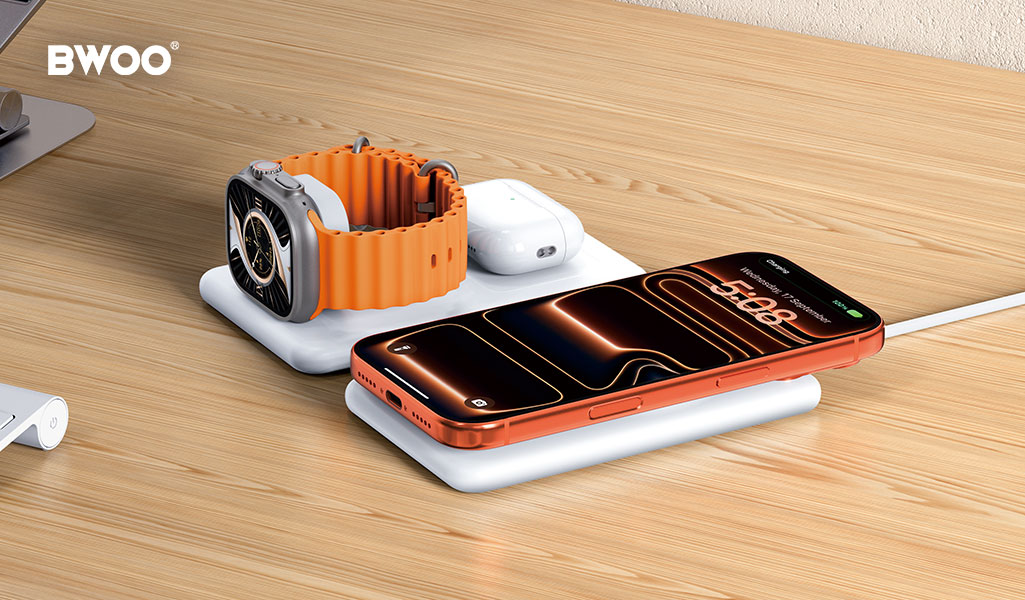
One Desk, Three Devices, One Big Question. Three cables on a desk feel outdated in 2026.
That's why 3-in-1 wireless charging stations—for phone, earbuds, and smartwatch—have become a clean, minimalist standard.
But a common concern remains:
"If I charge three devices at once, is the power split evenly?"
"Will charging speed drop dramatically?"
Yes, power is distributed—but not in the simple "divide by three" way most people imagine.
The Core Truth: How Power Distribution Actually Works
Think of a 3-in-1 wireless charger like a water reservoir, not a single pipe.
Independent Coil Design: No Power "Fighting"
High-quality 3-in-1 chargers, including BWOO models, use three independent transmitting coils inside.
What this means:
Each coil is dedicated to a specific device—phone, earbuds, or watch.
They don't compete or "steal" power from one another.
This is fundamentally different from low-cost designs that share coils and cause instability.
Fixed Power Allocation: Not Equal, But Intentional
Most 3-in-1 chargers follow a fixed allocation strategy.
Typical example (22.5W total output):
Smartphone: up to 15W
Wireless earbuds: 5W
Smartwatch: 3W
Key insight:
Even if only your phone is placed on the charger, it usually won't jump to 22.5W.
Charging power is capped by the phone's wireless charging protocol—not by unused capacity.
Why Charging Sometimes Feels Slow: The Real 3 Culprits
When performance disappoints, the charger itself is rarely the real issue.
1. Power Adapter Bottleneck
Common mistake:
Using an 18W phone charger to power a 3-in-1 wireless station.
What happens:
After wireless conversion losses, there simply isn't enough power to drive three coils reliably—leading to slow speeds or unstable charging.
2. Thermal Throttling
Wireless charging naturally generates heat.
Three devices charging together means heat accumulation.
To protect batteries, the control chip reduces current automatically—prioritizing safety over speed.
3. Alignment and Foreign Objects
With multiple devices on one base, misalignment becomes easier.
Even small shifts can reduce induction efficiency and slow charging without warning.
The Consumer's Golden Rules for Choosing a 3-in-1 Charger
Check the Input Requirement
Always pair a 3-in-1 charging station with a 30W or higher PD/QC adapter.
Confirm Independent Coils
Each charging position should have its own dedicated coil, not a shared design.
Look for Proper Certification
Only chargers with Qi or Qi2 certification can guarantee stable multi-device compatibility and safety.
Conclusion:
3-in-1 Charging Is About Efficiency, Not Compromise
A well-designed 3-in-1 wireless charger doesn't slow you down—it simplifies your setup.
When power allocation is engineered correctly, multi-device charging becomes a smarter, cleaner, and more efficient way to power your daily essentials.


